2026 Best Passive Walking Robot Manufacturers?
A passive walking robot is judged less by spectacle than by its ability to use gravity, limb geometry, and momentum in a repeatable gait. That sounds simple. Building one is not. Small changes in foot shape, joint friction, or slope can alter its steps, so manufacturer claims deserve careful comparison.
In his 1990 paper “Passive Dynamic Walking,” robotics researcher Tad McGeer described a model that “requires no actuation other than a small torque impulse at the hip at the beginning of each step.” His work remains a useful reference point. It also reminds buyers that passive walking is not the same as ordinary motor-driven locomotion. A demonstration on a smooth ramp may reveal little about performance on uneven flooring, under different loads, or after repeated use.
This guide examines manufacturers and suppliers relevant to passive walking robot research and development in 2026. It considers published specifications, accessible technical documentation, build quality, customization, support, and evidence of real-world testing. Where details are unclear, that uncertainty matters. Research prototypes and commercial products are not always directly comparable, and a polished video is not a durability test. The shortlist should therefore help engineers, educators, and research teams ask better questions—not promise a universal winner. The comparison is imperfect; the field is still evolving.
What Defines a Passive Walking Robot?
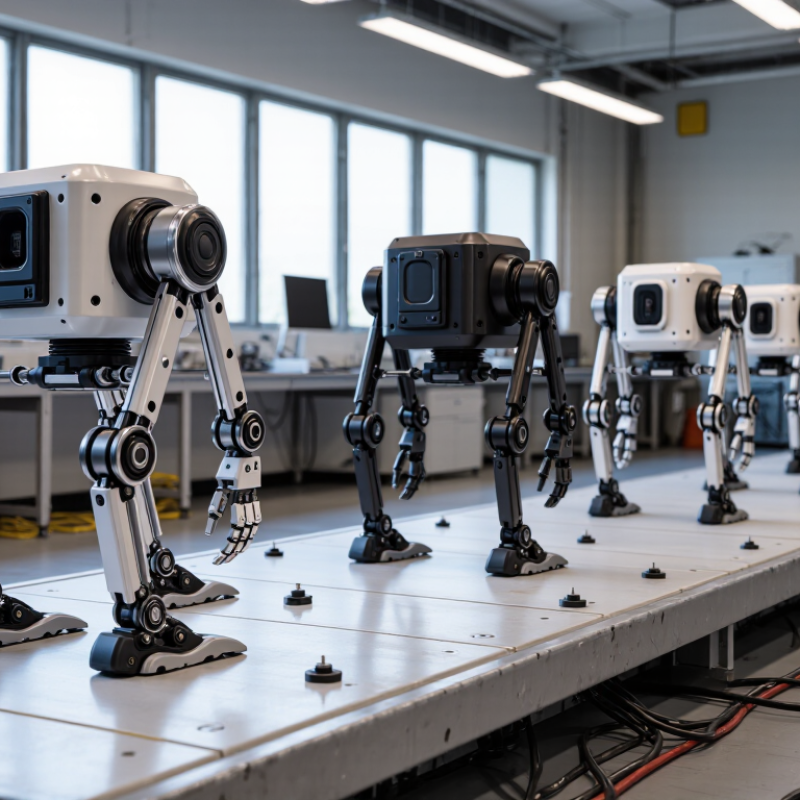
A passive walking robot uses its body mechanics and gravity to create much of its gait, rather than relying on motors to prescribe every step. Its legs may swing like pendulums, while joint placement, mass distribution, and compliant feet help produce a repeatable stride. On a gentle slope, some designs can walk with little or no active power. That is the key distinction. A robot does not become passive merely because it has few motors.
Real systems often use small actuators to start walking, steer, or recover from a stumble. The boundary is a little messy. A useful test is whether the robot’s structure and momentum do most of the step-to-step work. In testing, engineers can measure electrical energy per distance, walking speed, and recovery after a light push. The International Federation of Robotics’ World Robotics 2024 report counted 4,281,585 industrial robots operating worldwide in 2023, but it did not count passive walkers separately. That figure offers industrial context, not evidence of passive-walker adoption. For buyers, a manufacturer should explain test conditions, including slope angle, surface, payload, and whether control electronics remain active. Small details matter. A polished demo on a smooth ramp may hide poor performance on carpet or uneven flooring.
2026 Best Passive Walking Robot Manufacturers? - What Defines a Passive Walking Robot?
A passive walking robot uses its mechanical design and natural dynamics to produce a walking gait without continuous motor-driven control of that gait. Since there is no universal independent ranking of manufacturers, this table compares relevant design characteristics and practical evaluation criteria rather than assigning unsupported rankings.
| Evaluation Dimension |
What Defines the Design |
What to Verify |
| Source of walking motion |
In a purely passive dynamic walker, gravity and the robot’s mechanical dynamics drive the gait; motors do not continuously power the walking motion. |
Check whether the gait itself is unpowered or whether motors provide ongoing propulsion or joint torque. |
| Walking surface |
Many classic passive dynamic walkers rely on a shallow downhill slope to supply energy lost through impacts and other mechanical losses. |
Ask for demonstrations on the stated surface and slope; do not assume downhill performance implies level-ground walking. |
| Actuation and power |
A pure passive walker needs no motor actuation to generate its gait. A powered or semi-passive design may use actuators for propulsion, assistance, or gait initiation. |
Request a clear breakdown of which functions require electrical power and which occur through passive mechanics. |
| Sensing and control |
Passive gait generation does not depend on continuous active feedback in the way a motor-controlled gait does. Sensors may still be included for measurement, safety, or supervisory functions. |
Determine whether sensors merely monitor the robot or are required to produce or stabilize each step. |
| Mechanical design |
Leg geometry, mass distribution, joint arrangement, and impact behavior influence whether a repeatable passive gait can emerge. |
Look for documented design details and repeatable demonstrations, not just a claim that the robot “walks passively.” |
| Gait repeatability |
Passive walkers can have operating conditions tied to their mechanics and environment; changes in slope or surface can affect gait behavior. |
Compare repeated trials under the same stated conditions and request information about failures or operating limits. |
| Intended application |
Passive walking research is useful for studying locomotion, mechanical dynamics, and energy-efficient gait principles; it does not by itself establish suitability for general-purpose or commercial operation. |
Match the demonstrated capability to the intended use, such as research, education, or a specific experimental setup. |
| Evidence for comparison |
“Best” depends on requirements, and passive walking designs do not have one universally accepted manufacturer ranking or single performance measure. |
Compare published test conditions, gait demonstrations, technical documentation, support, and fit for purpose rather than relying on an unsupported overall rank. |
Note: “Passive” describes how the walking motion is generated; it does not necessarily mean that every component of a robot or test setup is unpowered.
How Passive Walking Robots Move Without Powered Actuation
Passive walking robots use gravity, momentum, and carefully shaped legs instead of powered joints to create steps. On a shallow slope, each leg swings like a pendulum while the body’s weight shifts forward. The foot lands, the stance leg supports the body, and the cycle repeats. No motors. No onboard controller. Collins, Wisse, and Ruina demonstrated this principle in a 2001 study of a three-dimensional, knee-equipped passive walker. Its simple gait depended on slope and mechanical design, not software.
Tips: Test on a gentle, even incline. Watch whether the feet land flat and the knees clear each other. Small changes in mass or joint friction can disrupt the rhythm.
The trade-off is important: passive walkers can move efficiently in controlled conditions, but they cannot easily handle uneven floors or change direction on demand. Their performance depends on geometry, balance, and the available slope. For broader context, the International Federation of Robotics’ World Robotics 2024 report counted 4,281,585 industrial robots operating worldwide in 2023. That figure reflects general automation, not passive-walker adoption or performance. Passive walking remains a specialized design approach, and its limits deserve attention alongside its elegance.
Criteria for Evaluating Passive Walking Robot Manufacturers
A passive walking robot can look convincing on a smooth ramp, then stumble when the surface changes. Evaluate manufacturers using repeatable tests, not demonstration videos alone. Ask for gait data across several ramp angles, surface materials, and payloads. Small details matter.
The International Federation of Robotics’ World Robotics 2024 report records 4,281,585 industrial robots operating worldwide in 2023. This is broad industry context, not a passive-walking market estimate. For this specialist category, request test logs showing completed steps, falls, and operating conditions. Check whether the manufacturer documents frame materials, joint wear, and repair procedures. A clear test protocol is more useful than impressive claims. Still, reported results may not match your intended terrain.
Tips: Request a live trial on a ramp with a measured incline and a textured surface. Ask how many repeated runs produced stable walking, and whether the results include failures. Compare units using the same setup. Not just demos. Also check spare-part availability and technical support; these details are easy to overlook.
2026 Best Passive Walking Robot Manufacturers? — Evaluation Criteria
Suggested evaluation weights for comparing manufacturers of passive walking robots. These weights are an assessment framework, not measured market data or manufacturer ratings.
Prioritize demonstrated gait stability, adaptability, and mechanical robustness. Assess each manufacturer using comparable test conditions, documented results, and clearly stated safety procedures.
Notable Passive Walking Robot Manufacturers in 2026
Notable Passive Walking Robot Manufacturers in 2026 are easier to compare by expertise than by headline claims. Research-led manufacturers often focus on compliant joints, low-friction bearings, and gait testing on gentle slopes. Education-focused suppliers tend to offer simpler, repairable frames for classroom demonstrations. Specialized engineering firms may provide custom prototypes, but public performance data can be limited. Look for published test conditions, not just polished videos.
The International Federation of Robotics’ World Robotics 2024 report counted about 4.28 million industrial robots operating worldwide in 2023, a 10% increase from 2022. This signals a broad manufacturing base, not proven expertise in passive walking. Passive designs depend on gravity and mechanical dynamics, so small changes in leg length, joint friction, or surface angle can alter a gait. Sometimes a simpler frame works better. That is worth testing.
Tips: Ask for repeatable walking trials on a specified slope and surface. Check whether the robot walks without external power, how quickly parts wear, and whether replacement components are available. A short demo is not enough. Request measurements across multiple runs, including failed attempts; manufacturers do not always publish them.
How to Compare Manufacturers for Research and Development Needs
Selecting a passive walking robot manufacturer for research and development starts with the experiment, not the catalog. Define the intended payload, step length, terrain, and whether the device must operate without powered actuation. Ask for dimensional drawings, material specifications, and documented test conditions. A gait video is useful, but it cannot show repeatability or joint friction. Request raw measurements when possible.
Tips: Send the same test brief to every candidate. Include load, slope, surface, and cycle count. Ask how they record failures, not only successful runs. Measure before you decide. A short sample evaluation can reveal loose fasteners, inconsistent foot contact, or setup steps missing from the manual.
Compare engineering support as carefully as the hardware. Can the team explain design limits, share interface details, and accommodate sensor mounting without changing the walking mechanism? Clarify replacement-part lead times and whether prototypes can be adjusted in small increments. For research, traceable revisions matter; record configuration, test date, and observed behavior. Some answers may remain uncertain until a unit is tested in your lab. That is not a reason to reject a manufacturer, but it is a reason to document assumptions and avoid comparing unlike test results.