Top Smart Locker Lock Manufacturers in China for Buyers?

Choosing a Smart Locker Lock manufacturer in China takes more than comparing unit prices. Buyers need to understand how the lock performs on a real locker, with repeated use, changing users, and occasional rough handling. Security technologist Bruce Schneier’s reminder, “Security is a process, not a product,” offers a useful lens for evaluating these systems. It is not a locker-specific quotation, but the principle applies: hardware, access controls, software, and ongoing support all matter.

Ask manufacturers about locking mechanisms, credential options, emergency access, battery life, and integration with your locker management platform. Request samples and test them on the actual door thickness and materials you plan to use. A lock that feels solid on a showroom panel may behave differently on a thin metal door. Small details matter. Check how the supplier handles firmware updates, replacement parts, quality inspections, and technical questions after delivery. Ask for test records and clear product specifications, rather than relying on broad claims. Not every factory will provide the same level of detail.

This guide outlines Chinese manufacturers and practical criteria for comparing them, including product range, customization, communication, and production capability. The right partner depends on your site, users, and service expectations—not simply the lowest quotation. No checklist is perfect. I would still verify samples and claims independently before making a large order, because supplier profiles can change and published information may be incomplete.
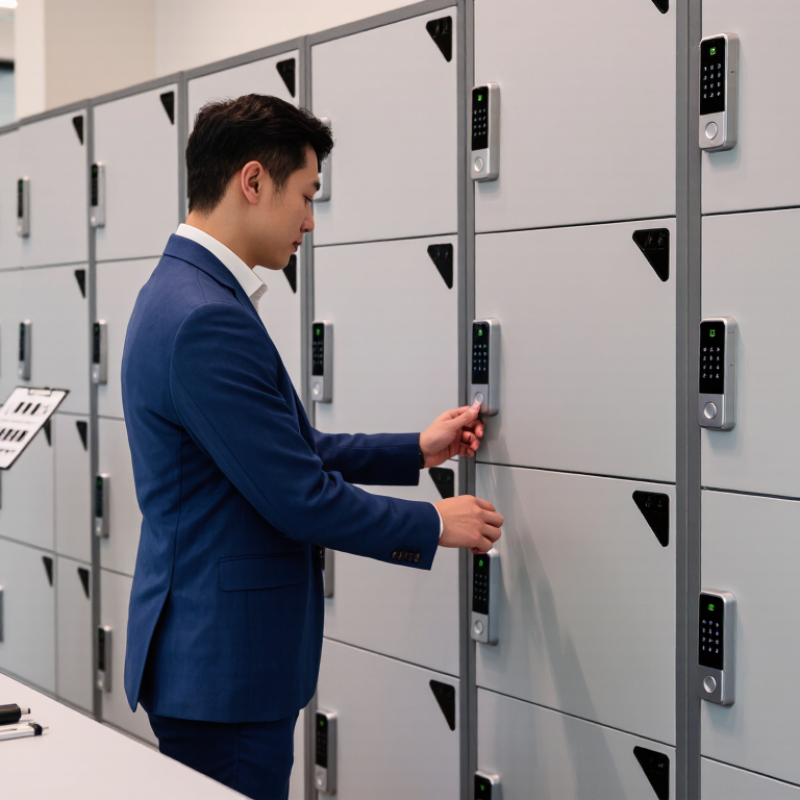
Top Smart Locker Lock Manufacturers in China for Buyers?

What Smart Locker Locks Are and How They Work

A smart locker lock replaces a conventional key with an electronic way to control access. Depending on its design, it may accept a PIN, an RFID card, or a mobile credential. Inside the door, a small controller checks that credential and signals a motor or solenoid to release the latch. No match, no opening. Some models record access events, which can help facility staff investigate a locker that was left open.

The user experience is simple. A person enters a code or presents a card, hears a short beep, and pulls the handle. After use, the lock secures the door again, either automatically or after a set action. Power may come from batteries or a wired supply. Battery-powered units are easier to install, but staff need a clear way to check low-power alerts and provide backup access. Small details matter.

For buyers comparing manufacturers in China, ask how the lock behaves during a power failure, how credentials are added or removed, and whether the latch fits the locker material and door thickness. Request test results and installation guidance, not just a feature list. A digital lock can still fail when a door is misaligned or a battery is neglected. That part is easy to overlook. A sample installation often reveals more than a polished specification sheet.

Smart Locker Lock Technologies: Common Wireless Frequencies

Smart locker locks may use RFID/NFC credentials or wireless connections such as Bluetooth and Wi-Fi. This chart compares representative frequencies, not product performance. Actual bands can vary by region and implementation.

Buyer note: Frequency alone does not determine wireless range, security, or reliability. Check the lock’s credential options, encryption and access-management features, and local radio regulations.

Reference points: LF RFID 125 kHz; HF RFID/NFC 13.56 MHz; U.S. UHF RFID band 902–928 MHz (915 MHz shown as a representative midpoint); Bluetooth and 2.4 GHz Wi-Fi operate in the 2.4 GHz ISM band.

Core Technologies Used in Smart Locker Lock Systems

Smart locker lock systems rely on more than a motorized latch. At the door, users may present an RFID card, enter a PIN, or unlock through a phone credential. A controller verifies the credential and signals the lock to release. The mechanism must move cleanly, even when a locker door is slightly misaligned. Small details matter. A status sensor can confirm whether the door is closed, while an event log records access attempts for later review. These features help facility teams spot jammed doors and recurring faults.

Networked locks send instructions and status updates through wired connections or wireless protocols. Encryption helps protect credentials in transit, but security also depends on careful setup and software maintenance. Connectivity can fail. A well-planned system should define what happens during an outage, such as allowing authorized local access without losing later event records. Power deserves attention too. Battery life varies with use, signal strength, and temperature. Buyers should test locks on the actual cabinet type, check replacement access, and review how alerts appear on staff devices. No design is perfect; real-world trials often reveal weak points that a specification sheet misses.

How to Evaluate Chinese Smart Locker Lock Manufacturers

How to Evaluate Chinese Smart Locker Lock Manufacturers

Evaluate engineering evidence, not showroom claims. Grand View Research estimated the global smart locker market at USD 2.39 billion in 2023 and projected a 15.2% compound annual growth rate through 2030. That growth makes supplier capacity worth checking, but it does not prove product reliability. Ask for test reports tied to the exact lock model, plus batch traceability and documented quality checks.

Test samples under real use. Run repeated locking cycles, check emergency power access, and measure battery life with the intended network connection enabled. Ask how the lock behaves after a network outage, low battery, or incorrect credential entry. Small details matter. Verify enclosure protection claims against IEC 60529 test evidence, where relevant, rather than relying on a printed rating. A factory visit can reveal whether inspection stations and production records match the supplier’s description.

Assess integration and after-sales support before placing a large order. Request protocol documentation, firmware update procedures, spare-part lead times, and a clear warranty process. Confirm that the manufacturer can reproduce the same configuration across production batches. And yes, a polished sample can still hide weak batch control. No checklist catches everything. Use a pilot installation, then review failures, response times, and maintenance effort before scaling.

Leading Smart Locker Lock Manufacturers in China

China’s smart locker lock manufacturers serve parcel rooms, campuses, offices, and residential buildings. The demand is substantial: the State Post Bureau reported 132.07 billion express-delivery items in China in 2023, up 19.4% year over year, in its postal industry statistics. That volume makes reliable access control more than a convenience. Buyers should examine lock-cycle testing, emergency power options, audit logs, and compatibility with the locker’s control system. Small details matter. A latch that sticks after repeated use can slow an entire delivery room.

Leading manufacturers typically combine mechanical design, electronics, and production testing rather than supplying a lock alone. Ask for evidence of endurance tests, clear installation drawings, and sample units tested on your own locker doors. Check whether the supplier can support different door thicknesses and provide replacement parts over time. Ask about data handling, too, especially when access records are stored or transmitted. A factory visit can reveal useful details, but it cannot replace documented quality checks. Supplier capabilities vary, and a polished sample may not reflect every production batch. That gap deserves attention. Compare test records, communication speed, and after-sales response before choosing a long-term partner.

How Buyers Can Compare Suppliers and Verify Product Quality

When comparing Chinese smart locker lock suppliers, look beyond unit price. Grand View Research estimated the global smart locker market at about US$1.12 billion in 2023 and forecast 11.5% annual growth through 2030. That signals expanding demand, not consistent product quality. Small details matter. Request a side-by-side specification sheet covering operating voltage, unlocking method, rated cycle life, emergency access, warranty, and firmware support. Ask suppliers to define each figure and provide dated test records.

Verify performance with production samples, not showroom units. Run repeated locking cycles with the actual door, latch, and load; test low-voltage behavior and recovery after power loss. For outdoor installations, request an IP-rating report and check that the tested model matches the quoted lock. IEC 60529 defines enclosure ingress-protection classifications, but an IP claim alone does not prove long-term durability. Inspect connector fit, cable strain relief, and whether the latch binds when the locker door is slightly misaligned.

Compare suppliers’ quality controls as carefully as their hardware. Ask how they trace batches, handle failed units, and notify buyers about design or firmware changes. Request a factory audit or independent inspection before shipment, then compare randomly selected units against the approved sample. A polished spreadsheet can still hide gaps. I would treat unsupported cycle-life claims as estimates, not evidence, and record acceptance criteria in the purchase agreement.

Top Smart Locker Lock Manufacturers in China for Buyers? - How Buyers Can Compare Suppliers and Verify Product Quality

Comparison Dimension What Buyers Should Compare Evidence to Request How to Verify
Product and configuration match Check lock type, dimensions, mounting method, latch direction, connector, controller compatibility, and included accessories. Confirm that quotations refer to the same configuration. Dimensioned drawings, wiring diagrams, bill of materials or configuration sheet, and a quotation identifying the exact model and options. Compare the documents with a production sample. Record the model, hardware revision, firmware version, and options on the purchase specification.
Access methods and system integration Compare supported access methods, such as RFID cards, PIN codes, mobile access, or a wired controller. Check supported card types, communication interfaces, and software integration requirements. Interface specifications, supported credential details, API or protocol documentation where applicable, and a demonstration using the intended locker-management system. Test the exact credentials, controller, and software planned for deployment. Do not assume that two products described as “RFID” or “Bluetooth” are automatically compatible.
Mechanical durability Compare latch and housing materials, operating-cycle claims, loading conditions, and the supplier’s definition of a successful cycle. Test report identifying the tested configuration, sample quantity, cycle procedure, operating conditions, and failure criteria. Check that the report covers the quoted product and request samples for repeated operation under the intended installation conditions. Set acceptance criteria before ordering.
Environmental protection Assess suitability for indoor, humid, dusty, or exposed installations. Compare any claimed IP rating with the actual installation environment. Test report identifying the product configuration and the claimed IP code, if an IP rating is specified. IEC 60529 defines the IP Code classification for enclosure protection. Verify the reported rating and test scope; do not treat an IP claim as proof of corrosion resistance.
Corrosion resistance Compare materials, coatings, fasteners, and the intended exposure conditions, especially for damp or coastal locations. Material and coating specifications, plus a corrosion-test report where corrosion performance is claimed. ISO 9227 specifies neutral salt-spray, acetic-acid salt-spray, and copper-accelerated acetic-acid salt-spray test methods. Agree on the applicable method and pass criteria with the supplier; the standard itself does not set universal product pass limits.
Electrical, battery, and emergency operation Compare rated voltage, current, power source, battery type and replacement method, low-power behavior, and operation during power or network loss. Electrical specifications, wiring diagram, battery details, and written instructions for emergency access, manual release, or recovery. Test normal operation and documented power-loss or network-loss scenarios on a sample. For lithium batteries shipped separately or within equipment, confirm whether UN 38.3 transport test documentation applies to the battery shipment.
Regulatory and material documentation Identify the destination market and check the requirements applicable to the finished product and its components. SKU-specific declarations, relevant test reports, and supporting material documentation for the target market. For EU sales, assess whether the product falls within the scope of applicable requirements, including RoHS Directive 2011/65/EU where relevant. CE marking is a regulatory conformity marking, not a general product-quality grade; check the applicable legislation and supporting documentation for the exact product.
Quality-management controls Compare inspection procedures, traceability, handling of nonconforming products, and control of product changes. Current quality-management-system certificate, certificate scope, issuing body details, and sample inspection records. Verify the certificate with its issuing or accreditation body and confirm that its scope covers the relevant manufacturing activities. ISO 9001 concerns a quality-management system; it does not certify that every individual lock meets a particular performance level.
Production consistency and shipment inspection Compare incoming-material checks, in-process inspections, final testing, batch identification, and agreed defect handling. Inspection plan, sample production records, traceability format, and a written acceptance-inspection procedure. Approve a pre-production sample, define critical functional checks and acceptance limits in writing, and inspect a production batch against the approved specification before shipment.
Warranty, spare parts, and support Compare warranty duration and exclusions, replacement-part availability, troubleshooting support, firmware maintenance, and response arrangements. Written warranty terms, spare-parts list, support process, and product-change notification policy. Confirm that the terms identify the covered products, start date, remedy, shipping responsibility, and process for reporting defects. Keep approved specifications and sample records with the purchase order.